
Guide to Free College
Introduction
Transparency Alabama’s mission is rooted in the idea that people cannot meaningfully participate in government or hold public institutions accountable if they do not understand how those institutions work. Our theory of change starts with the principle that when people gain access to knowledge that institutions and social networks do not distribute equitably, they gain greater capacity to make informed decisions and exercise agency over their own lives.
The Guide to Free College applies that same principle to higher education. We made this guide to help young people access information about the financial realities and opportunities surrounding college. By providing information on scholarship eligibility, student loan borrowing, and the relationship between college and government, we hope to help young people make informed decisions about financing their education.
Note for Students: College tuition, financial aid, and institutional policies are shaped in part by decisions made by governments at the local, state, and federal levels. As you read this guide, keep in mind that understanding who makes these decisions (and how they are made) can help you better understand your options and navigate the institution of college once you are enrolled. We dive deeper into this relationship between college and government in Section 4.
We know this is a long guide. The 2 most important resources we’ve created for you are:
*If viewing on mobile, we strongly recommend switching to desktop view!!!
1) How to Pay for College
1. Automatic Merit Scholarships
The #1 opportunity we hope students take away from this guide is the existence of automatic merit scholarships.
So what is an automatic merit scholarship?
Automatic merit scholarships are scholarships awarded to students who meet predetermined academic criteria (such as GPA and standardized test scores). “Automatic” literally means “automatic” if you hit x GPA and y ACT/SAT. These are excellent opportunities because you do not have to compete against other applicants. Some scholarships may still require a separate application or have specific deadlines, so it's important to check the requirements for each award.
For Alabama residents, these scholarships can make attending an in-state public university significantly more affordable. Some cover full tuition, while others may also provide funding toward housing or other educational expenses.
We created a spreadsheet to help you research automatic merit scholarships!!!
The table below compiles automatic merit scholarships available to in-state students at public universities in Alabama. Use it to compare eligibility requirements, award amounts, deadlines, and other important details as you explore your options. Pay particular attention to whether a scholarship covers full tuition, whether the university accepts ACT or SAT superscores, and when you must apply. Deadlines for scholarship eligibility or priority consideration are sometimes different from general admission deadlines.
Roadmap
This guide will cover:
1) How to Pay for College
Automatic Merit Scholarships (aka, how to get free college)
Applying for Federal Aid
FAFSA Explained
Pell Grants
Student Loans
Federal vs Private Student Loans
Subsidized vs Unsubsidized Student Loans
Interest Rates
2) How to Apply for College
Application Overview
Resources for Applying to College
3) How to Graduate College Once You Get There
Degree Requirements
How to Plan Your Degree Path
4) Relationship between College & Government
What is College?
Demystifying Institutional Structure & Decisionmaking
Funding Higher Education
5) Alternative Options to College
Community College & 2-Year Programs
Transfer Credits Explained
Trade School
6) Your Next Step
Important note: Scholarship requirements, award amounts, and deadlines can change. Verify the current requirements with each university before making decisions about testing, applications, or enrollment.
If you would prefer to view the table in Google Sheets, click here.
Applying for Federal Aid
FAFSA Explained
If you've started looking into paying for college, you've probably heard someone mention the FAFSA. But what is it, and why does everyone keep talking about it?
FAFSA stands for Free Application for Federal Student Aid. It's the form you fill out to find out what kinds of federal financial aid you may qualify for to help pay for college. Colleges and some state financial aid programs also use FAFSA information to determine eligibility for their own aid.
Here's the important part: filling out the FAFSA does not mean you're agreeing to take out student loans. The application can help you access grants, work-study opportunities, and federal student loans. You can review your options before deciding whether to borrow money.
How does it work?
Complete the FAFSA. Start at StudentAid.gov. The application is free, so you should never have to pay someone just to submit it. You'll provide information about yourself and, depending on your circumstances, your parent(s) or other required contributors.
Review your results. After processing, you'll receive a FAFSA Submission Summary with information about your application and your Student Aid Index (SAI). The SAI is an index colleges use to help determine your eligibility for certain types of financial aid. It is not a bill, and it is not necessarily the amount your family will be expected to pay.
Review your financial aid offers. The colleges you list on your FAFSA can use your information to determine what aid you may qualify for. Compare the offers you receive to understand how much you might pay out of pocket, how much grant and scholarship money you receive, and whether loans are included.
Complete any remaining requirements. You may need to provide additional information or complete other steps before your aid can be finalized.
A few things to know:
Apply even if you think your family earns too much. You might qualify for aid you weren't expecting, and colleges can have different eligibility criteria for their own financial aid programs.
Pay attention to deadlines. Federal, state, and college deadlines may differ. Some financial aid is limited, so applying early can matter. Check the relevant deadlines for the academic year you plan to attend.
Submit the FAFSA every year. Financial aid eligibility can change, so you'll generally need to complete a new FAFSA for each academic year.
You don't have to figure everything out alone. Your high school counselor and the financial aid offices at the colleges you're considering can help you understand the process.
For more information and to apply, visit StudentAid.gov.
Pell Grants
One of the most important reasons to complete the FAFSA is to find out whether you qualify for a Federal Pell Grant.
Unlike a student loan, a Pell Grant generally does not have to be repaid. It's federal grant assistance intended primarily for eligible undergraduate students who demonstrate financial need and meet other program requirements.
In other words, this is money that can help pay for college without adding student loan debt.
How much can you receive?
The amount you may qualify for depends on factors such as your financial circumstances, your enrollment status, your cost of attendance, and the applicable federal eligibility rules. There is a maximum award amount that can change from year to year, so check the current limits rather than relying on an old figure you find online.
Pell Grant funding can generally be used toward eligible college expenses, including tuition, fees, and other education-related costs. Your college determines how the funds are applied and disbursed.
Do you have to pay it back?
Generally, no! However, repayment can sometimes be required. For example, if you withdraw from school and receive more federal aid than you were eligible to keep. Make sure you understand the conditions attached to your aid.
How do you qualify?
Start by completing the FAFSA. Your eligibility is determined using federal requirements and the information in your application. Eligibility is not based on a single universal income cutoff, so don't assume you won't qualify without checkinYou can learn more about Pell Grants and other types of federal student aid at StudentAid.gov.
Remember: Grants and scholarships are generally the first types of aid to investigate because they typically don't need to be repaid. Before accepting student loans, make sure you understand how much you'd borrow and what repayment could look like after graduation.
Student Loans
Sometimes scholarships and grants aren't enough to cover the full cost of college. If you're considering student loans to cover the difference, it's important to understand what you're borrowing, how interest works, and what repayment could look like after graduation.
The big thing to remember: a student loan isn't free money. It's money you borrow now and agree to repay later, usually with interest. The amount you borrow today affects how much you'll owe in the future, so it's worth understanding your options before signing anything.
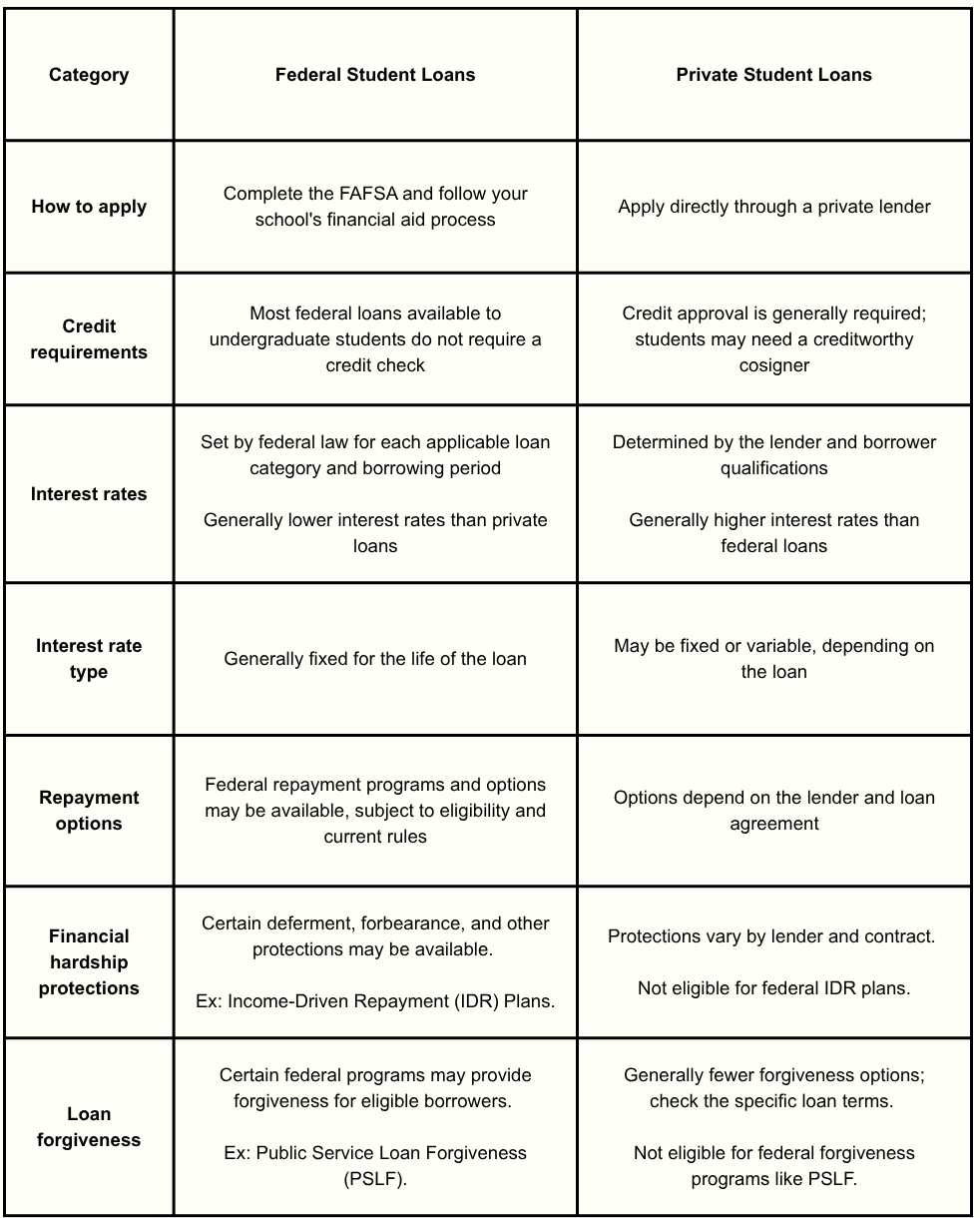
1) Federal vs Private Student Loans
Not all student loans come from the same place. The two main categories are federal student loans and private student loans.
Federal student loans are offered through the federal government. You apply for them through the financial aid process, starting with the FAFSA. Federal loans have terms and borrower protections established by federal law and program rules.
Private student loans are offered by private lenders, such as banks, credit unions, and other financial institutions. Each lender sets its own eligibility requirements and loan terms, subject to applicable law. Approval and interest rates may depend on factors such as your credit history, income, and whether you have a cosigner.
Here's how they compare:
Which should you consider first?
For many students, federal student loans are the better place to start because they offer standardized terms and protections that private loans may not provide. Private loans can sometimes fill a funding gap, but compare their interest rates, fees, repayment terms, and hardship options carefully before borrowing.
Before taking out either type of loan, make sure you've explored scholarships, grants, and other sources of funding that don't require repayment.
One more thing: you don't have to accept every loan offered in your financial aid package. Review the amount you actually need and borrow accordingly. An offered loan is an option, not an obligation.
Other Resources
https://studentaid.gov/aid-estimator/: Use the Federal Student Aid Estimator to estimate how much federal aid you may be eligible for. This is an estimate, not the actual FAFSA application.
https://studentaid.gov/repayment-calculator/plan-options: Use the Repayment Calculator to estimate your monthly payment amounts based on different hypothetical student loan balances.
A general rule of thumb for total student loan debt is to borrow no more than what you expect to make as your first year’s salary. For example, someone who expects to make $40,000 in their first year of working after college should generally aim to take out $40,000 or less in total student loan debt.
2) Subsidized vs Unsubsidized Student Loans
If you're an undergraduate considering federal student loans, you'll likely encounter two terms: Direct Subsidized Loans and Direct Unsubsidized Loans.
The difference matters because it determines who pays the interest during certain periods of your education.
1) Direct Subsidized Loan
Direct Subsidized Loans are available to eligible undergraduate students who demonstrate financial need.
While you're enrolled at least half-time, the federal government generally pays the interest on your subsidized loan. The government also generally covers interest during the six-month grace period after you leave school or drop below half-time enrollment, and during qualifying deferment periods.
That means your loan generally won't accumulate interest during those covered periods.
2) Direct Unsubsidized Loans
Direct Unsubsidized Loans are available to eligible undergraduate and graduate students, and eligibility does not depend on demonstrating financial need.
The key difference? Interest starts accruing when the loan is disbursed.
Even while you're in school, interest accumulates on an unsubsidized loan. You generally aren't required to make payments while enrolled at least half-time, but the interest doesn't simply disappear because you're not making payments.
If you leave that interest unpaid, it may be added to your principal balance under certain circumstances. When that happens, future interest can accrue on the larger balance.
What's the difference in practice?
Imagine you borrow $5,000 at a hypothetical fixed interest rate of 6% per year.
Subsidized loan: If you qualify and remain in a period when the government covers your interest, the loan generally stays at $5,000 during that period.
Unsubsidized loan: Interest starts accumulating from disbursement. At a simple annual rate of 6%, $5,000 accrues approximately $300 in interest over one year.
This is an illustration, not a current federal loan rate or a repayment quote. Actual interest depends on the loan's rate, disbursement date, and applicable rules.
You may be eligible for both types of federal loans, but subsidized loans have additional eligibility requirements and limits.
What should you do? If you're offered both, compare the amounts and terms. When you qualify for subsidized loans, they can be particularly valuable because the government covers interest during certain periods. Unsubsidized loans can still be useful, but understand that interest begins accruing while you're in school.
3) Interest Rates
Interest is the cost of borrowing money. When you take out a student loan, you generally agree to repay the original amount you borrowed (the principal) plus interest.
Your interest rate is one of the factors that determines how much borrowing will ultimately cost you.
Fixed vs. variable interest rates
A fixed interest rate stays the same for the life of the loan. This makes the interest rate more predictable.
A variable interest rate can change over time, depending on the loan's terms and the benchmark to which it is tied. Your payments or the amount of interest you pay may increase if the rate rises.
Federal student loans generally have fixed interest rates. Private student loans may offer fixed or variable rates.
How are federal student loan interest rates determined?
Federal student loan interest rates are established under federal law and depend on the type of loan and the applicable borrowing period. Rates can change for new loans from one academic year to the next.
That means a rate you see in an older article or on a friend's loan documents might not be the rate offered for your own borrowing period.
For current federal rates, visit the "Federal Student Aid website" (https://studentaid.gov/understand-aid/types/loans/interest-rates).
How much does interest matter?
Let's use a hypothetical example.
Suppose you borrow $10,000 at a fixed annual interest rate of 6%. If you made no payments and interest accrued at that rate for one year, the loan would accrue approximately $600 in interest.
The longer you carry a balance, the more interest you may pay over the life of the loan. Your actual costs depend on the repayment schedule, payment amounts, loan terms, and whether unpaid interest is added to the principal.
This is why the amount you borrow matters just as much as the interest rate. A lower rate can reduce borrowing costs, but borrowing less in the first place can reduce them even further.
Don't forget loan fees!
Interest isn't the only cost to consider. Some loans have origination fees, which are charges deducted from the loan proceeds when the loan is disbursed.
For example, if a loan has an origination fee, the amount credited toward your college expenses may be less than the amount you are required to repay. Federal student loans can have origination fees, and private loan fees vary by lender.
When comparing loans, look at the interest rate, fees, repayment terms, and total amount you expect to repay (not just the amount offered).
Before you borrow
Before accepting a student loan, ask yourself:
Have I applied for scholarships and grants I might qualify for?
Do I understand the difference between the amount offered and the amount I actually need?
Is the interest rate fixed or variable?
Are there origination fees or other charges?
When does interest begin accruing?
What will repayment look like after I leave school?
What options are available if I struggle to make payments?
You don't need to predict your entire financial future to make a good decision. But you should understand the terms you're agreeing to before you borrow.
For more information about federal student loans, repayment options, and current program requirements, visit "StudentAid.gov" (https://studentaid.gov/).
2) How to Apply for College
Applying to college can feel like a lot of paperwork, deadlines, and unfamiliar terminology. The good news? You do not have to figure everything out at once. Once you understand the basic process, you can break it into smaller steps and work through them one at a time.
The application process varies by college, so always check the requirements and deadlines for each school you are interested in. You do not need to know everything before you get started.
1. Application Overview
Step 1: Decide Where to Apply
Before filling out applications, make a list of colleges you might want to attend. Think about more than just whether a school has your intended major. Consider:
Cost and financial aid: What would you actually have to pay after grants and scholarships?
Location: How far from home do you want to be? Would you need to pay for housing and transportation?
Programs: Does the school offer the majors, certificates, or other programs you are interested in?
Admissions requirements: Do you meet the school's academic and other requirements?
Campus and student support: What resources are available for tutoring, advising, disability accommodations, and other needs
You do not have to apply to every school on your list. The goal is to identify colleges that make sense for your interests, circumstances, and budget.
Step 2: Find Out What Each Application Requires
Every college has its own application requirements. Depending on the school and program, you may need some combination of:
An online application with your personal and educational information.
Your high school transcript, which lists your courses and grades.
SAT or ACT scores, if required or if you choose to submit them.
An application essay or personal statement.
Letters of recommendation from teachers, counselors, or other people who can speak to your qualifications.
Information about extracurricular activities, employment, volunteering, or other experiences.
An application fee or a fee waiver.
Do not assume every college requires all of these things. Some schools have test-optional admissions, some do not require essays, and some offer applications without an application fee. Requirements can also differ by applicant type and academic program.
Make a checklist for each college so you know exactly what you need to submit.
Step 3: Keep Track of Deadlines
College applications can have different deadlines, including early application deadlines, regular admission deadlines, and deadlines for particular programs or scholarships.
Create a calendar or spreadsheet with the following information for each school:
Application deadline.
Deadline for transcripts and test scores, if applicable.
Essay and recommendation requirements.
Scholarship and financial aid deadlines.
Application fee or fee waiver information.
Date you submitted your application.
Any follow-up tasks or missing materials.
Important: Getting admitted to a college and receiving financial aid or scholarships are not always the same process. A college may require separate scholarship applications, additional financial aid forms, or earlier deadlines to qualify for certain awards. Check each school's requirements instead of assuming that submitting one application covers everything.
Step 4: Complete and Submit Your Application
Follow the instructions for each college's application. Read questions carefully, check your information for mistakes, and make sure all required sections are complete.
If you use an application platform that lets you apply to multiple colleges, remember that individual schools may still have additional requirements. For example, a college might request a supplemental essay or additional information after you submit the main application.
Before submitting, check that you have:
Entered your information accurately.
Completed all required sections.
Submitted any required essays and supplemental materials.
Arranged for transcripts or other documents to be sent.
Reviewed the application for missing information.
Checked whether you need to pay an application fee or request a fee waiver.
Save a copy of your confirmation and keep track of your login information. You may need to return to the application portal to check your status or submit additional materials.
Step 5: Check Your Application Status and Respond to Decisions
Submitting an application is not necessarily the last step. Check your email and each college's applicant portal for updates, requests for additional information, admissions decisions, and deadlines.
Once you receive decisions, compare your options. Look at the actual cost of attendance after grants and scholarships, not just the advertised tuition price. Consider housing, transportation, books, food, fees, and other expenses that may affect whether you can afford to attend.
If you are admitted, follow the school's instructions for accepting your offer, completing any enrollment requirements, and meeting financial aid deadlines.
Remember: You do not need to have your entire college career figured out before applying. You need to understand the next step, know where to find the requirements, and give yourself enough time to complete them.
2. Resources for Applying to College
You do not have to navigate the application process alone. These resources can help you understand the process, complete your applications, and find assistance when you need it.
General College Application Guides
U.S. News & World Report: A Complete Guide to the College Application Process: A broad overview of the college application process, useful if you want a more detailed explanation of what to expect.
GirlSpring: The Ultimate College Apps Guide: An additional application guide aimed at helping students work through the process.
Applying Through Common App
Common App: First-Year Students: Start here if you are applying to college for the first time and want to use Common App. The platform allows students to apply to multiple participating colleges through a shared application, although individual colleges may have additional requirements.
Not every college uses Common App. If a school you are interested in does not participate, check its admissions website for instructions on how to apply.
Application Fee Waivers
Applying to multiple colleges can get expensive. Many colleges charge an application fee, but you may qualify for a fee waiver that lets you apply for free.
Fee waivers may be available to students who demonstrate financial need, participate in certain college-access programs, or meet other eligibility criteria. The requirements vary by college and application platform.
How to find an application fee waiver:
Check the application itself. Platforms such as Common App may offer fee waivers to eligible students.
Ask your high school counselor. They can help you determine whether you qualify and whether your school can verify your eligibility.
Contact the college's admissions office. Some colleges offer their own fee waivers or have additional eligibility criteria.
Look for special programs. College-access organizations, campus recruitment events, and other programs may provide application fee waivers.
Free Application Week: Many colleges participate in Free Application Week, a week when application fees are waived for all applicants. The actual week of Free Application Week varies by state. In Alabama, Free Application Week is usually in early October.
Don't assume you can't afford to apply just because an application has a fee. Before paying, check whether a waiver is available. If you qualify, you may be able to apply to more schools without spending money on application fees.
Where Else Can You Get Help?
You may also be able to get application assistance from:
Your high school counselor: Ask about application requirements, transcripts, recommendation letters, deadlines, and fee waivers.
College admissions offices: Contact the colleges directly if you have questions about their requirements or application status.
College access and college readiness programs: Local and national programs may offer application workshops, advising, essay assistance, or help navigating admissions.
Public libraries and community organizations: Some offer college application workshops or connect students with volunteers who can help.
Teachers and mentors: Ask early if you need a recommendation letter or feedback on an essay.
If you do not have access to a college counselor, do not assume you are out of options. You can contact admissions offices directly and ask what resources are available to prospective students.
One last tip: Start with the college's official admissions website whenever you need to confirm a requirement or deadline. General guides can help you understand the process, but the college itself is the best place to verify what you need to submit.
3) How to Graduate College Once You Get There
Getting into college is one accomplishment. Graduating is another.
College can give you more control over what you study, but it also requires you to keep track of requirements, deadlines, and decisions that affect your progress toward graduation. You might have to complete general education courses, take classes required for your major, meet minimum grade requirements, and finish courses in a particular order.
The good news is that these requirements are usually documented somewhere. You do not have to rely entirely on an academic counselor to tell you what classes to take. Learning how to find and use your school's degree requirements can help you make informed decisions, avoid unnecessary classes, and take ownership of your education.
1. Degree Requirements
What Is a Degree Requirement?
A degree is not simply a collection of college credits. To graduate, you generally need to complete a specific set of academic requirements established by your college and your degree program.
Think of your degree as a checklist. You need enough credits, but those credits must also satisfy the right requirements.
Depending on your school and program, your degree requirements may include:
General education requirements: Courses intended to give students a broad educational foundation, such as writing, mathematics, natural sciences, humanities, or social sciences.
Major requirements: Courses that focus on your primary field of study. For example, a biology major may need to complete particular biology, chemistry, and mathematics courses.
Concentration or specialization requirements: Some majors allow you to focus on a particular area within the field.
Electives: Courses you can choose within the limits of your degree program. Some degrees have free electives, while others restrict which electives count.
Prerequisites: Courses or other requirements you must complete before enrolling in a more advanced course.
Minimum grade or GPA requirements: Some programs require you to earn a particular grade in certain classes or maintain a minimum GPA to continue in the major or graduate.
Credit and residency requirements: Your school may require you to complete a minimum number of credits overall or earn a certain number of credits at that institution.
Not every degree has the same requirements. A bachelor's degree in engineering, for example, may have a more prescribed course sequence than a degree with a large number of elective credits. Requirements can also differ between colleges, even when the degree titles are identical.
The important thing is to understand the requirements for your specific degree program, not just the general requirements for graduating from college.
How to Find Your Degree Requirements
Your college's website is one of your most important tools. Schools use different names for the relevant pages and documents, but you can often find what you need by searching for terms such as:
Undergraduate catalog
Academic catalog
Degree requirements
Program of study
Degree plan
Major requirements
Course sequence
Four-year plan
General education requirements
For example, if you are interested in majoring in psychology, you could search for “[College Name] psychology degree requirements” or “[College Name] undergraduate catalog psychology.”
Once you find the relevant page, look for the requirements for the specific degree and catalog year that apply to you. Your college may have different requirements for students who entered in different years, and a Bachelor of Arts may have different requirements from a Bachelor of Science in the same field.
You may encounter a few different kinds of resources:
The academic catalog explains the official requirements for degree programs and often includes course descriptions, prerequisites, and academic policies.
A degree plan or program checklist organizes the courses and credits you need to complete.
A sample four-year plan shows one possible sequence of courses across eight semesters. It can be useful for planning, but it may not account for your individual circumstances.
A degree audit compares your completed and in-progress coursework against your degree requirements. Depending on your school, it may identify requirements you have already met and those you still need to complete.
These resources serve different purposes. A sample four-year plan is a useful starting point, but it is not necessarily a personalized graduation plan. A degree audit can help you track your progress, but you still need to understand what it is showing you and check that your courses satisfy the requirements you expect them to satisfy.
If you cannot find the information online, ask your academic department or registrar's office where the official requirements are published.
Check Whether You Have Already Met Any Requirements
Before registering for a class, check whether you have already earned credit that might satisfy part of your degree requirements.
You may have earned college credit or qualifying scores through programs such as:
Advanced Placement (AP): High school courses and exams administered through the College Board.
International Baccalaureate (IB): Coursework and exams completed through an IB program.
Dual enrollment: College courses completed while you were in high school.
College-level examination programs: Certain exams, such as CLEP exams, may be accepted for college credit.
Other approved examinations or prior coursework: Depending on the institution, additional exams, transfer courses, or other forms of prior learning may qualify.
Do not assume that every passing score or completed course automatically counts toward your degree. Each college sets its own rules for accepting exam scores and transfer credit. The amount of credit awarded, the minimum score required, and the degree requirement satisfied may vary by school, exam, subject, and program.
To investigate:
Search your college's website for “AP credit,” “IB credit,” “CLEP credit,” “exam credit,” or “transfer credit.”
Find the institution's official credit policy or equivalency chart.
Check which scores qualify, how much credit is awarded, and which course or degree requirement the credit satisfies.
Submit official score reports or transcripts if the school requires them.
Check your student record or degree audit to confirm that the credit was received and applied correctly.
For example, an AP exam might give you credit for an introductory course. That could mean you do not need to take that course again. But the credit might count only as an elective, might not satisfy a particular major requirement, or might not be accepted by your program at all.
Credit awarded and degree requirements satisfied are not always the same thing. Confirm how the credit applies to your particular degree before building your schedule around it.
If you think qualifying credit is missing from your record, contact the appropriate office and ask how to have it evaluated.
2. How to Plan Your Degree Path
Once you understand your degree requirements, you can use them to plan your schedule. This is where you move from knowing what you need to graduate to making decisions about how you will get there.
Academic counselors and advisors can be valuable resources. They may know about program changes, course restrictions, registration procedures, and graduation policies that are not obvious from a website. But you should not have to depend entirely on someone else to tell you which classes to take.
Advisors can help you make decisions. You can do the research that allows you to participate in those decisions.
Step 1: Build Your Own Degree Checklist
Start with the official requirements for your degree and turn them into a checklist or spreadsheet.
For each requirement, record:
The course or requirement you need to complete.
The number of credits it is worth.
Any minimum grade requirement.
Any prerequisites.
Whether you have already completed it or have credit that may satisfy it.
Whether the course is required for your major, general education, or another
part of your degree.
Any restrictions on when or how the requirement can be fulfilled.
You can organize the checklist by category, such as general education, major
requirements, electives, and other graduation requirements.
As you complete courses, update your checklist and compare it with your
school's degree audit. This gives you a way to monitor your progress rather
than waiting until registration or your final
semester to discover that you are missing something.
Keep a copy of the official requirements that apply to you. If your college
changes its curriculum, you will want to know which requirements govern
your degree and whether any changes affect you.
We created a Degree Checklist Spreadsheet to help you organize this information!Click here to make a copy of the template.
The spreadsheet has two tabs:
Degree Checklist: A fill-in tracker with 50 rows for degree requirements, dropdown menus, and a progress snapshot.
How to Use: Step-by-step instructions for finding requirements, checking prior credit, updating progress, and keeping official records.
Step 2: Understand Which Classes Must Come First
Some courses can be taken in almost any order. Others cannot.
A prerequisite is a course or requirement you must complete before enrolling in another course. For example, an upper-level biology course might require you to complete introductory biology and chemistry first.
A corequisite is a course or requirement that must be completed at the same time as another course, unless the school allows an exception.
These requirements matter because one missed class can affect several semesters of planning. If Course B requires Course A, and Course A is offered only once a year, postponing Course A could delay Course B (and potentially your graduation).
When reviewing course requirements, check the course descriptions and prerequisites in the academic catalog. Do not assume that you can take courses in any order simply because they appear next to each other on your degree checklist.
Step 3: Find Out When Courses Are Offered
A course appearing in your degree requirements does not necessarily mean it will be offered every semester.
Some courses are offered every fall and spring. Others are offered only once a year, rotate between semesters, or are available only when there is sufficient demand or an instructor is available.
Before deciding when you will take a course, look for:
The current and upcoming semester schedules.
Past course schedules, if the school makes them available.
Department announcements about planned course offerings.
The course's prerequisites and any restrictions on enrollment.
Past schedules can help you identify patterns. For example, if an advanced course has appeared in the spring schedule for the past several years but not in the fall schedule, you should investigate whether it is normally offered only in spring.
However, past offerings are clues, not guarantees. A department can change its schedule, cancel a class, or offer a course in a different semester. If your graduation plan depends on taking a particular course at a particular time, ask the department whether the expected offering is reliable.
You can often find historical schedules by searching your college's website for “course schedule archive,” “previous semester schedules,” or “class schedule.” If older schedules are not publicly available, contact the department or registrar's office.
Step 4: Map Out Your Semesters
Now combine your degree checklist, prerequisites, and course-offering information into a semester-by-semester plan.
You do not need to predict every detail of your next four years perfectly. Your goal is to create a workable plan that helps you see what needs to happen and when.
For each semester, consider:
Which required courses can you take now?
Which courses are prerequisites for requirements you will need later?
Are any required courses offered only during particular semesters?
How many credits can you reasonably manage?
Are you balancing difficult courses or courses with significant lab, clinical, internship, or fieldwork commitments?
Are there registration restrictions, minimum grades, or other conditions you need to satisfy?
Could a course conflict with work, transportation, caregiving, or other responsibilities?
For example, suppose your degree requires Course A before Course B, and Course B is offered only in the spring. If you want to take Course B in your second spring semester, you need to make sure you complete Course A early enough to qualify. Your plan should reflect that sequence instead of treating both courses as interchangeable items on a checklist.
Also consider your own circumstances. A schedule that looks ideal on paper may not be realistic if it requires you to work late every night, travel to campus five days a week, or take several demanding courses at once. Planning is not just about finishing as quickly as possible; it is about finding a sustainable path to graduation.
Step 5: Register Strategically and Revisit Your Plan
Course planning does not end once you have made a schedule. Registration may involve limited seats, waitlists, time conflicts, and restrictions on who can enroll in a course.
Before registration opens, identify the courses you need and a few alternatives in case your first choices are unavailable. If a required course fills up, contact the department or advisor to ask about your options and whether the delay could affect your graduation timeline.
At the end of each semester, update your checklist and degree plan. Account for courses you completed, courses you need to repeat, changed requirements, and any new information about future offerings.
You should also check your degree audit periodically and resolve discrepancies early. If a course appears not to count toward the requirement you expected it to satisfy, ask the registrar, department, or academic advisor to clarify the issue.
Step 6: Use Advisors as a Resource, Not a Substitute for Your Own Research
You are allowed to ask for help. In fact, you should ask questions when a requirement is unclear, a degree audit looks incorrect, or a course sequence could delay graduation.
The difference is that you can come to those conversations prepared.
Instead of asking only, “What classes should I take next semester?” you could say:
“I checked my degree requirements, and I believe these three courses are still outstanding. Am I interpreting the requirements correctly?”
“This course is a prerequisite for a class offered only in spring. Does this schedule give me enough time to complete both?”
“My degree audit lists this requirement as incomplete, but I have AP or transfer credit that I thought would satisfy it. Who can review that?”
“I noticed this course has not appeared in recent fall schedules. How can I confirm when it will next be offered?”
“If I cannot enroll in this required course, what alternatives are available, and could the delay affect my graduation date?”
These questions help you get specific answers and create a record of what you have learned. If you receive conflicting information, consult the official catalog and ask the appropriate office to resolve the discrepancy.
No plan is completely immune to changes. Courses can be canceled, requirements can change, and life can interrupt even the most carefully organized schedule. The point is not to control every variable. It is to understand your options well enough to respond when something changes.
You are the person who has the most to gain from graduating with the degree you set out to earn. Learn the requirements, make a plan, check your progress, and ask questions when something does not make sense. You do not have to navigate college alone, but you can take an active role in navigating it.
4) The Relationship between College & Government
College can feel like a world of its own. There are admissions offices, professors, financial aid departments, university presidents, boards of trustees, and state and federal agencies. Each has a different role in determining what college looks like, what it costs, and what opportunities students can access.
Understanding these relationships matters because college affordability is not determined by any single person or institution. It is shaped by decisions about public funding, tuition, financial aid, institutional priorities, and the laws governing higher education.
This section explains how colleges fit into the broader system of government, who makes decisions about higher education, and where the money that supports colleges comes from.
1. What Is College?
Colleges Are Institutions, Not Just Places to Take Classes
A college is an institution that provides education beyond high school. Colleges and universities may offer associate, bachelor's, master's, professional, or doctoral degrees, depending on the institution.
But a college is also an organization. Like other organizations, it has leadership, employees, operating expenses, rules, and decisionmaking structures. It must determine how to spend money, which academic programs to offer, whom to hire, how much to charge students, and how to distribute available resources.
These decisions are shaped by the kind of institution a college is and the laws that govern it.
Public Colleges vs. Private Colleges
One important distinction is whether a college is public or private.
Public colleges and universities are established or operated under governmental authority. They often receive funding from state or local governments, although the amount and structure of that support vary by institution. They may also receive tuition payments, federal funds, grants, donations, and other revenue.
Private colleges and universities are operated by private organizations rather than as public institutions. Their funding may come from tuition, private donations, endowments, grants, and other sources. Some private institutions receive government funding for particular programs or activities.
Neither category tells you everything about a college's funding or governance. Public colleges can depend heavily on tuition and other revenue, while private colleges may receive public funding for eligible programs.
The distinction matters because a college's legal structure influences who governs it, how it is accountable, and which governmental rules apply.
Why Does Government Have a Role in Higher Education?
Education in the United States is shaped by both state and federal government, but those governments do not have identical roles.
The U.S. Constitution does not expressly assign education a general governing role to the federal government. Under the Tenth Amendment, powers not delegated to the federal government or prohibited to the states are reserved to the states or the people. State governments consequently have a central role in organizing and regulating education. (U.S. Const. amend. X.)
The federal government nevertheless influences education through legislation, funding, and regulatory oversight. Congress can establish education-related programs under its constitutional authority, and federal agencies administer laws and programs enacted by Congress.
The federal government's role in funding and overseeing education includes the U.S. Department of Education as a principal federal agency involved in educational funding, coordination, technical assistance, and regulatory oversight.
This division of authority is important: states have a central role in structuring higher education, while the federal government influences colleges through applicable federal laws and funding programs.
What Does This Mean for Alabama Students?
In Alabama, the state government plays an important role in public higher education. The state legislature establishes legal frameworks for educational institutions, and state law determines the powers and responsibilities of different governing bodies.
The important distinction is that K–12 public schools and public colleges are not governed through exactly the same institutional structure.
For example, Alabama law expressly distinguishes institutions of higher learning governed by boards of trustees from public schools under the general supervision of the State Board of Education. The Alabama Legislature also established a separate board of trustees for the state's community and technical colleges. These distinctions appear in Ala. Code § 16-3-11 and § 16-60-110.
Understanding which institution has authority over a particular decision is the first step toward understanding how higher education works.
2. Demystifying Institutional Structure & Decisionmaking
Who Runs a College?
A college is not governed by one person who makes every decision. Different people and bodies have different responsibilities, and their authority depends on applicable law and the institution's governing documents.
The following roles provide a starting point for understanding how college decisionmaking works.
Board of trustees or governing board
A governing board provides institutional oversight and exercises the powers assigned to it by law and the institution's governing documents. Depending on the institution, its responsibilities may include overseeing institutional leadership, approving major plans, and making decisions about institutional priorities.
The precise powers of a board are not universal. A public university's board, a community college's governing board, and the governing body of a private college may operate under different legal frameworks.
President or chancellor
A college president or university chancellor generally leads the institution's administration. This leadership role involves implementing institutional priorities and overseeing the people and departments responsible for daily operations.
Administrators and departments
Academic affairs, admissions, financial aid, student affairs, and finance offices handle different parts of institutional operations. Their responsibilities may be established through institutional policies, delegated authority, and applicable laws.
Faculty and academic leadership
Faculty members and academic administrators participate in academic decisions, including teaching, curriculum, and academic standards. The scope of their authority depends on institutional policies and governance arrangements.
Students
Students are affected by institutional decisions and may have opportunities to participate in student government, public meetings, advisory bodies, and other forms of campus governance. The extent of that participation varies by institution.
What Does a Board of Trustees Actually Do?
A board of trustees is especially important because it can sit between an institution's administration and the larger governmental or organizational structure in which the institution operates.
Think of the board as a governing body whose authority comes from a legal framework, not simply from the fact that its members hold an important title.
For public colleges, that framework may include state constitutional provisions, state statutes, and institutional governing documents. For private colleges, it may include the institution's corporate charter, bylaws, and applicable state law.
A board's authority may affect major institutional questions, but it does not necessarily have unlimited control over every decision.
For example, to understand who can change a public university's tuition, you would need to determine which body has the legal authority to set tuition, whether state law imposes restrictions, and whether the state legislature or another governing entity has a role.
Similarly, understanding who can establish or discontinue a degree program requires examining the institution's applicable governance rules and approval requirements.
The practical lesson: When you want to know who is responsible for a college policy, do not assume that the president, board of trustees, or state legislature has the answer simply because that person or body holds a position of authority. Identify the actual source of its power.
How Does State Government Fit Into College Governance?
State government can influence public higher education through legislation, appropriations, and the legal structures governing institutions.
The state legislature passes laws establishing or modifying the legal framework for public institutions. It also makes decisions about state spending through the legislative appropriations process.
The governor and executive branch participate in carrying out state law and the state budget. Their specific authority over higher education depends on the applicable legal framework.
State higher education agencies and governing bodies may oversee institutions, coordinate programs, or exercise powers assigned to them by law.
Institutional governing boards and administrators exercise their own delegated or statutory authority within that framework.
These roles should not be treated as interchangeable. A legislature's authority to appropriate public money does not automatically mean it directly manages every college operation. Likewise, a university's authority to manage its operations does not mean it can disregard state law or the conditions attached to public funding.
The precise allocation of power depends on the relevant statutes and governing documents.
How Does the Federal Government Fit Into College Governance?
The federal government influences higher education through federal legislation, funding programs, and regulatory oversight.
Congress enacts federal laws, and executive agencies administer those laws within their assigned authority. Federal requirements may apply to colleges receiving particular forms of federal assistance or participating in federally regulated programs.
The Constitution's Supremacy Clause establishes that the Constitution and valid federal laws made pursuant to it are the supreme law of the land. When applicable federal and state requirements conflict, federal law may preempt state law. (U.S. Const. art. VI, cl. 2.)
This does not mean the federal government directly runs every college. Rather, federal authority operates through particular constitutional powers, laws, and programs.
Who Is Accountable for Decisions?
A useful way to understand college governance is to ask three questions:
Who has the authority to make the decision? Identify the governing board, administrator, agency, legislature, or other body with legal or delegated authority.
Where does that authority come from? Look for the applicable statute, constitutional provision, institutional policy, or governing document.
How can the decision be reviewed or challenged? Depending on the issue, there may be internal review procedures, public oversight, administrative processes, or judicial review.
Public accountability is particularly important when a college uses public funds or exercises authority established by state law. However, the specific transparency requirements that apply to a college or its governing board must be determined under the laws governing that institution.
Understanding accountability helps students move beyond the idea that college policies are simply rules handed down by an institution. Policies are created and implemented by decisionmakers operating within a particular structure of authority.
3. Funding Higher Education
Where Does College Money Come From?
Colleges need money to operate. They must pay employees, maintain buildings, provide academic programs, purchase equipment, operate libraries and laboratories, and support student services.
That money can come from several sources:
State appropriations: Money allocated by a state government to support public institutions or designated educational purposes.
Tuition and fees: Payments charged to students for enrollment, instruction, or particular services.
Federal funding: Money provided through federal programs, grants, contracts, or other authorized mechanisms.
Private donations and endowments: Contributions from individuals, foundations, and other donors, including investment income generated by endowment funds.
Other revenue: Depending on the institution, revenue may come from research, auxiliary services, partnerships, and other activities.
The mix of these revenue sources varies across institutions. A public university and a private college may have very different financial structures, and even two public institutions may depend on different combinations of state support, tuition, grants, and other revenue.
What Is a State Appropriation?
A state appropriation is money that a legislature authorizes for a designated governmental purpose.
In Alabama, the state legislature plays a central role in deciding how state funds are allocated. For public higher education, understanding the state budget is therefore an important part of understanding the financial environment in which institutions operate.
State appropriations can help support institutional operations, but an appropriation does not necessarily cover every expense a college incurs. Institutions may still depend on tuition, fees, grants, and other revenue.
It is also important to distinguish between the amount of money a state allocates to an institution and the institution's total operating budget. Those are not necessarily the same thing.
To understand how a particular Alabama college is funded, students would need to examine the applicable state appropriations, the institution's financial reports, and the other revenue sources available to it.
How Does Federal Funding Work?
The federal government can support education through legislation authorizing funding programs and through agencies that administer those programs.
The uploaded study guide identifies the U.S. Department of Education as a major federal actor involved in educational funding, coordination, technical assistance, and regulatory oversight. It also explains that Congress has enacted legislation affecting educational institutions and educational funding.
For college students, federal funding is especially relevant because federal programs can provide assistance directly to eligible students or support particular institutional activities.
However, funding a college and helping a student pay for college are two different things. Money provided to an institution does not automatically become financial aid for every student enrolled there. Likewise, a grant or other form of assistance awarded to an eligible student is not the same as a general appropriation to a college.
The specific programs, eligibility rules, and conditions governing federal assistance must be examined separately.
How Does College Funding Affect Tuition?
Tuition is one part of the larger financial structure of a college.
An institution's ability to pay for its operations depends on the resources available to it and the expenses it must cover. State appropriations, tuition revenue, federal funding, donations, and other sources can all contribute to that picture.
This creates an important connection between government decisions and college affordability.
For example, a change in state funding may affect the resources available to a public institution. But the effect on tuition is not necessarily automatic or identical across institutions. The outcome depends on the institution's financial circumstances, applicable laws, and the authority responsible for setting tuition.
Similarly, a college may receive funding for a particular purpose without being free to use that money for unrelated expenses or distribute it directly to students.
To understand whether a particular funding decision will make college more affordable, ask:
Who receives the money: the institution, the student, or another organization?
What may the money be used for?
Who decides how the money is allocated?
Does the funding reduce the student's actual cost of attendance?
Is the funding available to every student or only to those who meet specific eligibility requirements?
These questions help distinguish between a policy that supports higher education generally and one that directly reduces the amount a student must pay.
Why Does This Matter for Free College?
A college's advertised tuition is not necessarily the same as what an individual student ultimately pays. Financial aid and other forms of assistance may reduce a student's costs, but the amount of assistance available depends on the relevant programs, eligibility requirements, and institutional policies.
Likewise, a state or institution may describe a program as providing free tuition without necessarily covering every expense associated with attending college.
Students should therefore distinguish between tuition and the total cost of attendance. Depending on the institution and the program, students may need to account for fees, books, supplies, transportation, housing, food, and other expenses.
The relationship between college and government matters because decisions about public funding, institutional budgets, and financial aid influence which costs can be covered and who qualifies for assistance.
Understanding these relationships helps students ask better questions about promises of free college:
What exactly is covered?
Who pays for it?
Who qualifies?
Which institution or government body administers the program?
What happens if the program's funding or eligibility rules change?
These are not just accounting questions. They are questions about who has the power to make college affordable, how that power is exercised, and which students benefit from the resulting decisions.
Putting It All Together
Higher education operates within a system of shared but distinct responsibilities. State and federal governments establish laws and funding programs. Governing boards and institutional administrators exercise authority under the rules applicable to their institutions. Colleges assemble resources to provide educational programs, and students navigate the resulting tuition charges, financial aid opportunities, and other costs.
Understanding this structure gives students a more complete picture of how college works. It also helps them recognize that college affordability is not determined solely by the price listed on a college's website. It is shaped by decisions about institutional governance, public investment, funding eligibility, and the allocation of resources.
Knowing 1) who makes those decisions, and 2) where their authority to make those decisions comes from is a useful first step toward understanding how to make college affordable.
4. Where Does Power Come From?
When a college makes a decision, someone has to have the authority to make it. But where does that authority come from? Who decides what a college can do, who gets to make decisions on its behalf, and what happens when someone exceeds their authority?
In the United States, government power is structured by law. The Constitution establishes the framework for government, legislatures enact statutes, and authorized government bodies and officials carry out laws and adopt rules within the powers granted to them. Court decisions also help determine what the law means and whether government action is lawful.
These sources of authority are connected, but they are not interchangeable. A government official cannot simply do whatever they want because they hold office. A statute cannot override the U.S. Constitution. And an agency or board cannot automatically exercise every power that the legislature might possess.
The basic principle is that having the power to make a decision and having the legal authority to make that decision are two different things. To understand who has authority over a particular issue, you need to know which laws apply, what powers those laws grant, and what limits they impose.
The Constitution: Establishing the Framework
The U.S. Constitution establishes the structure of the federal government, distributes power between the federal government and the states, and places limits on government authority.
The Tenth Amendment reserves powers not delegated to the federal government, nor prohibited to the states, to the states or the people. Education has traditionally been an area of substantial state and local responsibility, although federal constitutional requirements and federal laws also affect education.
The Supremacy Clause, found in Article VI, Clause 2, establishes that the U.S. Constitution, federal laws made pursuant to it, and treaties are the supreme law of the land. When state law conflicts with valid federal law, federal law may take precedence.
The Constitution also gives the federal government tools that affect education. Article I, Section 8, Clause 1 authorizes Congress to tax and spend for the common defense and general welfare. Congress uses its spending authority to fund education-related programs, often subject to conditions established by federal law. Article II, Section 3 requires the President to take care that the laws are faithfully executed.
Together, these provisions help explain why education is primarily governed through state systems while still being affected by federal funding, federal legislation, and constitutional protections.
Statutes: Laws Enacted by Legislatures
A statute is a law enacted by a legislative body. At the federal level, Congress enacts federal statutes. In Alabama, the Legislature enacts state statutes.
Statutes can establish government institutions, assign responsibilities to public officials and boards, authorize programs, and set requirements that institutions must follow.
For example, Alabama Code § 16-3-11 establishes the State Board of Education's general control and supervision over public schools, while distinguishing institutions of higher learning governed by boards of trustees. Alabama Code § 16-60-110, together with Act 2015-125, concerns the establishment of the Alabama Community Colleges Board of Trustees.
These laws illustrate an important point: the authority of one government body does not necessarily extend to every institution or every issue within the same broad subject area. The law may assign different responsibilities to different boards or officials.
Regulations and Institutional Rules: Putting Authority Into Practice
Legislatures do not personally administer every government program or make every operational decision. They may authorize agencies, boards, and other bodies to carry out laws and adopt regulations within the scope of their legal authority.
Regulations are legally binding rules adopted by authorized government bodies under powers granted to them by law. They must remain within the authority granted by the relevant statutes and comply with applicable constitutional and other legal requirements.
Colleges and universities also have governing boards, administrators, faculty bodies, and other decision-making structures. Depending on the institution and the issue, these bodies may have authority over matters such as academic requirements, institutional budgets, student conduct, admissions policies, or campus operations.
But the existence of a policy does not, by itself, answer every legal question about that policy. You may need to determine which body adopted it, what authority that body has, whether the policy conflicts with a higher source of law, and what procedures apply.
For example, a college's student handbook might explain a disciplinary process. The handbook can help you understand the institution's stated procedures, but it does not necessarily tell you the full extent of the institution's legal authority or all of your rights under applicable law.
Who Has Authority Over Colleges in Alabama?
Alabama's Constitution and statutes assign responsibilities to different education-related bodies. Those assignments matter because public education is not governed by one person or institution with unlimited authority.
For example:
Alabama Constitution, Article XIV, § 256 addresses educational policy and the Legislature's authority concerning the establishment and operation of schools.
Historical note: Unlike some state constitutions, the Alabama Constitution expressly states that it does not create or recognize a right to education or training at public expense. This language is tied to Alabama's history of racial segregation in education. Section 256 was amended in 1956, in the aftermath of Brown v. Board of Education (1954), as the Alabama Legislature pursued measures to resist federally mandated school desegregation. The provision formed part of a broader effort to preserve state control over education amid challenges to segregated schooling. Its language does not prohibit the state from providing public education. But it does expressly disclaim a constitutional right to publicly funded education.
Ask Yourself: Do you agree or disagree with this policy, and why?
Alabama Constitution, Article XIV, § 262 addresses the selection, qualifications, powers, duties, and tenure of the State Board of Education and Superintendent of Education.
Alabama Constitution, Article XIV, § 264 addresses the Board of Trustees of the University of Alabama.
Alabama Constitution, Article XIV, § 266 addresses the Board of Trustees of Auburn University.
Alabama Code § 16-3-11 addresses the State Board of Education's general control and supervision over public schools, with an exception for institutions of higher learning governed by boards of trustees.
Alabama Code § 16-60-110 and Alabama Act 2015-125 concern the Alabama Community Colleges Board of Trustees.
These provisions are starting points for understanding Alabama's education governance structure. They do not, by themselves, provide a complete account of every board's current powers or every rule governing a particular college. To investigate a specific decision, you may need to consult additional statutes, constitutional provisions, regulations, board policies, institutional rules, and relevant court decisions.
How to Use This Information
Understanding the sources of legal authority gives you a way to investigate decisions instead of assuming that a person or institution automatically has the right to make them.
Suppose your college tells you that a policy prevents you from registering for a course, receiving a particular benefit, or appealing a decision. You can start by asking:
Who made the decision? Was it a professor, department, administrator, governing board, state agency, or another body?
Where is the rule written down? Look for the relevant statute, regulation, board policy, academic catalog, student handbook, or institutional procedure.
What gives that person or body authority? Does a law, regulation, delegation of authority, or institutional governance document assign responsibility for this issue?
What limits apply? Does a higher source of law establish requirements or protections that the decision must respect?
What procedures are available? Is there an appeal, grievance process, administrative review, or other way to challenge the decision?
These questions will not automatically resolve every dispute. Some issues involve complicated legal questions, and the answer may depend on facts that are not obvious from a handbook or policy. But they give you a place to start.
You do not need to become a lawyer to ask where a rule came from, who has authority to enforce it, or what options you have when you think a decision was made improperly.
The point is not that every decision you dislike is unlawful. The point is that authority has a source, authority has limits, and understanding both helps you navigate the institutions that affect your life.
5) Alternative Options to College
A four-year college isn't the only way to get an education, build a career, or increase your earning potential. Depending on your goals, you might be better served by a community college, a two-year degree, a trade school, an apprenticeship, or a career and technical education program in high school.
These options aren't mutually exclusive. You could earn a certificate in high school, complete an associate degree at a community college, transfer to a four-year university, or start working while taking additional classes. You don't have to figure out your entire career right now! But it helps to understand your options before spending money on a program.
1. Community College & 2-Year Programs
What is a community college?
Community colleges are institutions that typically offer two-year associate degrees, shorter certificates, workforce training, and courses that may transfer to four-year colleges and universities. They often have lower tuition than four-year institutions and may offer flexible schedules, including evening, online, or part-time classes.
Community college can be a good option if you want to:
Save money on a bachelor's degree. You may be able to complete some or all of your general education requirements at a community college before transferring to a four-year institution.
Enter the workforce sooner. Some associate degrees and certificates prepare students for specific occupations without requiring a bachelor's degree.
Explore your interests. Taking lower-cost introductory courses may help you decide what you want to study before committing to a longer program.
Build academic confidence. You can complete college-level coursework and develop study skills in a different environment from a large university.
Continue working while in school. Depending on the institution and program, flexible scheduling can make it easier to balance school, employment, and family responsibilities.
Community college isn't automatically the cheapest option in every situation. Compare your actual cost after financial aid, including tuition, fees, transportation, books, equipment, and the time you may need to spend away from work. Also check whether you qualify for grants or scholarships at your local community college.
What can you do with a two-year degree?
An associate degree can qualify you for certain jobs, provide a foundation for further education, or help you advance in a field where you already work. Your options depend on the program, the local job market, and whether the occupation requires a license or certification.
Examples of career areas to investigate include:
Health care: Nursing, radiologic technology, respiratory care, dental hygiene, and other allied health fields. Some roles require an approved program, a licensing exam, clinical training, or additional certification.
Information technology: IT support, networking, cybersecurity support, and related technical roles. Employers may also expect industry certifications or relevant experience.
Engineering and industrial technology: Engineering technology, manufacturing, instrumentation, electronics, and industrial maintenance.
Business and administration: Accounting support, bookkeeping, logistics, supply chain operations, and office administration.
Public safety and public service: Certain emergency medical services, fire services, and other technical or public-service roles, depending on local requirements.
Skilled technical fields: Some programs prepare students for work in automotive technology, HVAC, welding, construction technology, and similar occupations.
These are examples to research, not promises that every associate degree leads directly to a job in that field. Some occupations require a specific type of degree, an accredited program, a license, or further education. For example, earning an associate degree in nursing does not mean you can automatically work as a registered nurse; you must meet the applicable education, examination, and licensing requirements.
Before enrolling: look at the job, not just the degree! Search for actual job postings in the area where you want to live. What education do employers require? Do they ask for a license, certification, experience, or a bachelor's degree? What is the advertised pay? Are entry-level positions available nearby? These answers can help you decide whether a program is a good investment.
Associate Degrees vs Certificates
A degree generally requires a broader course of study and may include general education courses alongside classes in your chosen field. An occupational certificate is usually designed to teach a more specific set of skills and may take less time to complete. Certificate programs vary considerably: some prepare you for entry-level work, while others provide additional training for people who already have experience.
Neither is automatically better. A certificate might be the fastest route into a particular occupation, while an associate degree might provide more opportunities for advancement or transfer to a bachelor's program. Check the requirements for the career you want before choosing.
How to Find Programs
Start with community colleges and technical colleges in your area. Search their websites for terms such as academic programs, associate degrees, career and technical education, workforce development, and certificates.
For every program you're considering, find out:
What degree or credential will you earn?
How long does it typically take to finish?
What is the total estimated cost, including fees, supplies, tools, uniforms, exams, and licensing expenses?
Is the program accredited or otherwise recognized by the relevant licensing board or industry?
Does it prepare students for a license or certification exam?
What are the program's graduation, examination pass, job-placement, and employment-outcome statistics, if available?
Can the credits transfer if you decide to pursue a bachelor's degree later?
What financial aid, scholarships, or workforce-training assistance might you qualify for?
Ask the school how it calculates its reported employment outcomes. A school's overall job-placement rate may not tell you how many graduates found jobs in their field, how much those jobs pay, or how many graduates were still looking for work.
2. Transfer Credits Explained
One strategy for reducing the cost of a bachelor's degree is to complete some coursework at a community college and then transfer to a four-year college or university. But there is an important catch: earning college credit does not guarantee that another school will accept it or that it will count toward your degree.
A receiving college may accept a course as elective credit but not allow it to satisfy a specific major requirement. It may also limit how many credits you can transfer, require a minimum grade, or apply different rules to courses in your intended major.
The best time to investigate transfer credit is before you register for the class, not after you've paid for it.
How to check whether a class will transfer
Step 1: Identify the college and degree you want to transfer into.
You don't necessarily have to commit to a particular university right away, but having a target school and major makes it much easier to check requirements. If you have several possible destinations, check each one: transfer policies can differ.
Step 2: Look for an official transfer guide or equivalency database.
Search the receiving college's website for terms such as:
Transfer equivalency guide
Transfer credit database
Course equivalency search
Transfer articulation agreement
Community college transfer pathway
Transfer admissions requirements
These resources may show how a course at your current institution is treated by the school you want to attend. Make sure the information applies to your specific sending college, course number, and intended degree.
Step 3: Check whether the credit will satisfy the requirement you need.
Ask two separate questions:
Will the receiving college accept this course for credit?
Will that credit count toward a specific requirement in my intended degree program?
For example, a university might accept a course as general elective credit without allowing it to replace the required introductory biology course for a particular major. The credits may transfer, but you might still have to take the biology course.
Step 4: Check the rules that could affect acceptance.
Confirm the minimum grade required, whether the course must be taken at an approved institution, whether it includes a lab or other required component, whether there is a limit on transfer credits, and whether your intended major has additional restrictions. Also check whether the receiving institution requires a particular course sequence.
Step 5: Ask the receiving college for confirmation before enrolling.
If the online database is unclear, or if the course isn't listed, contact the receiving college's transfer admissions office, registrar, or academic department. Explain the exact course you plan to take and the degree you want it to satisfy.
If possible, get the answer in writing and save it. Include the course title and number, the institution offering it, the term you plan to take it, and your intended major. Ask whether the answer is an official evaluation or only general guidance.
A useful email might look like this:
Subject: Transfer Credit Confirmation Before Enrollment
Hello,
I am considering taking [course title and number] at [current college] during [term]. I plan to transfer to [receiving college] and pursue a degree in [major].
Before enrolling, could you confirm whether this course is eligible for transfer credit and, if accepted, which requirement it would satisfy in my intended degree program?
Please let me know if you need a course description, syllabus, or other information to evaluate it.
Thank you!
Step 6: Save the evidence and check again if your plans change.
Keep copies of transfer guides, course descriptions, emails, and any written evaluations. Policies can change, and a course accepted for one major or catalog year may not meet the requirements for another. If you change schools or majors, check again.
What is an articulation agreement?
An articulation agreement is an arrangement between educational institutions that explains how specified courses, credits, or programs apply when a student transfers. Some agreements establish a pathway from a particular community college program to a particular bachelor's degree.
An articulation agreement can make planning easier, but read the actual conditions. You may need to complete a specific sequence of courses, earn a minimum GPA, meet deadlines, or apply to a designated program. An agreement for one degree does not necessarily apply to every major at the receiving university.
What about transferring an associate degree?
Some colleges have pathways designed for students who complete an associate degree before transferring. In certain arrangements, the associate degree may satisfy many general education requirements, while the university requires additional coursework for the major and bachelor's degree.
Don't assume that every associate degree automatically transfers as a complete package. Ask the receiving institution:
Does this specific associate degree qualify for a transfer pathway?
Which general education requirements will it satisfy?
Which courses will still be required for my intended major?
How many credits will apply toward the bachelor's degree?
Will any credits be accepted only as electives?
Are there minimum GPA, course, or application requirements?
The goal is not merely to transfer the largest number of credits. It's to transfer credits that actually move you closer to graduation.
Transfer planning: your money-saving checklist
Before taking a course that you expect to transfer, confirm:
The receiving college accepts the course or has a relevant transfer agreement.
The course meets the requirement you intend it to satisfy.
You understand the minimum grade and other conditions.
The credits will count toward your intended degree, not just as electives.
You have checked the relevant transfer-credit limits and deadlines.
You have saved the official guidance or written confirmation.
You have compared the cost of taking the course at each institution, including any financial aid you could lose or gain.
If you cannot get a clear answer, pause before paying for the course. It's better to spend a little more time verifying your plan than to discover later that you need to repeat a class.
3. Trade School
What is trade school?
Trade schools, also called technical schools or career schools, focus on preparing students for particular occupations through hands-on instruction and technical training. Depending on the program, students may learn through workshops, labs, simulations, clinical placements, internships, or work-based training.
Programs may lead to a certificate, diploma, associate degree, industry certification, or eligibility to pursue a professional license. Examples of fields that offer technical or vocational training include:
Electrical work
Plumbing
Heating, ventilation, and air conditioning (HVAC)
Welding and metal fabrication
Automotive and diesel technology
Construction and carpentry
Industrial maintenance and manufacturing
Aviation maintenance
Culinary arts
Cosmetology and barbering
Medical assisting and other health-related technical fields
The training required varies by occupation. Some careers require a license or apprenticeship in addition to classroom instruction. For others, employers may prioritize a recognized certification, hands-on experience, or a combination of credentials.
Trade school, community college, or apprenticeship?
These routes can overlap, but they are not the same.
Trade or technical school: Focuses on preparing students for a particular occupation or industry. Programs vary in cost, length, credential, and recognition.
Community college: May offer trade programs alongside associate degrees, general education courses, and transfer pathways. This can be useful if you want both technical training and the possibility of further college study.
Apprenticeship: Combines paid, supervised on-the-job training with related classroom instruction. Apprenticeships are common in some skilled trades, but availability and entry requirements vary by occupation and location.
High school career and technical education (CTE): Gives students an opportunity to explore or begin training in a career field before graduating from high school.
You do not necessarily have to choose only one. For example, a student might take technical classes in high school, complete an apprenticeship after graduation, and later pursue additional credentials to qualify for more advanced work.
Getting a Head Start in High School
If you're in high school, you may be able to start exploring a trade, or even earn industry credentials, before graduation. Look for career and technical education (CTE) programs offered through your high school, school district, or a regional career and technical center.
Depending on the program, students may have access to:
Hands-on courses in fields such as welding, construction, automotive technology, health sciences, information technology, or manufacturing.
Dual enrollment, which may allow eligible high school students to earn college credit through a participating college.
Industry-recognized credentials or certification exam preparation.
Work-based learning, internships, job shadowing, or cooperative education.
Career counseling and connections to employers or apprenticeship programs.
What is available depends on your school district, the program, eligibility rules, transportation, and the credentials offered. Taking a CTE class does not automatically mean you'll graduate with a professional certification. Ask exactly what credential, if any, the program prepares you to earn and whether you must pass an additional exam or meet an age requirement.
Start by asking your high school counselor or CTE coordinator:
What career and technical programs can students at my school access?
Are there programs at another high school or regional career center that I can attend?
Can I earn college credits, an industry credential, or both?
Are there fees for uniforms, tools, transportation, exams, or supplies?
Are internships, paid work-based learning, or registered apprenticeships available?
Will the training count toward any requirements for a college program or future license?
Are there age, grade-level, GPA, attendance, or application requirements?
If your school doesn't offer the field you're interested in, ask whether the district partners with a technical center, community college, employer, or apprenticeship sponsor. You may have options beyond the courses listed at your own high school.
How to evaluate a trade program
Before enrolling, investigate the program just as carefully as you would investigate a college.
Check the credential. What will you receive at the end: a certificate of completion, an industry certification, an associate degree, or eligibility to apply for a license? These are not interchangeable.
Check recognition and licensing requirements. If the occupation is regulated, confirm the requirements with the relevant state licensing board or other official authority. Ask whether the program satisfies the required education or training component. A school saying that it prepares students for a career is not, by itself, proof that its credential qualifies you for a license.
Calculate the full cost. Include tuition, fees, tools, equipment, protective clothing, books, transportation, exam fees, and any unpaid time required for training. Ask about scholarships, grants, employer sponsorship, and workforce-training assistance.
Investigate the outcomes. Ask how many students finish the program, pass the relevant certification or licensing exam, and find work in the field. Find out how those statistics are calculated and whether the school can provide information about typical starting pay.
Talk to people who do the job. If possible, speak with workers or employers in the field. Ask what the work is actually like, what entry-level jobs require, how pay changes with experience, and what advancement opportunities exist.
Don't overlook apprenticeships
In some occupations, an apprenticeship may be an alternative to paying for a full-time training program before entering the workforce. Apprentices typically receive paid, supervised work experience and related instruction, with the details depending on the program.
Search for registered apprenticeship opportunities through official workforce or apprenticeship resources, local employers, unions where applicable, and community colleges. Confirm whether the apprenticeship is paid, how wages progress, what training costs you may be responsible for, what credential you can earn, and what the application requirements are.
An apprenticeship is not guaranteed to be available in every trade or location, and getting a spot may be competitive. You may need to meet age, education, aptitude, physical, or other requirements.
6) Your Next Step
You don't have to decide your entire future before you graduate high school. Start by identifying a few careers that interest you, researching what qualifications they require, and comparing the education and training routes that can get you there.
The most useful question isn't simply, "Should I go to college?"
It's: "What do I want to be able to do, what qualifications do I need, and what's the most realistic way for me to get them?"